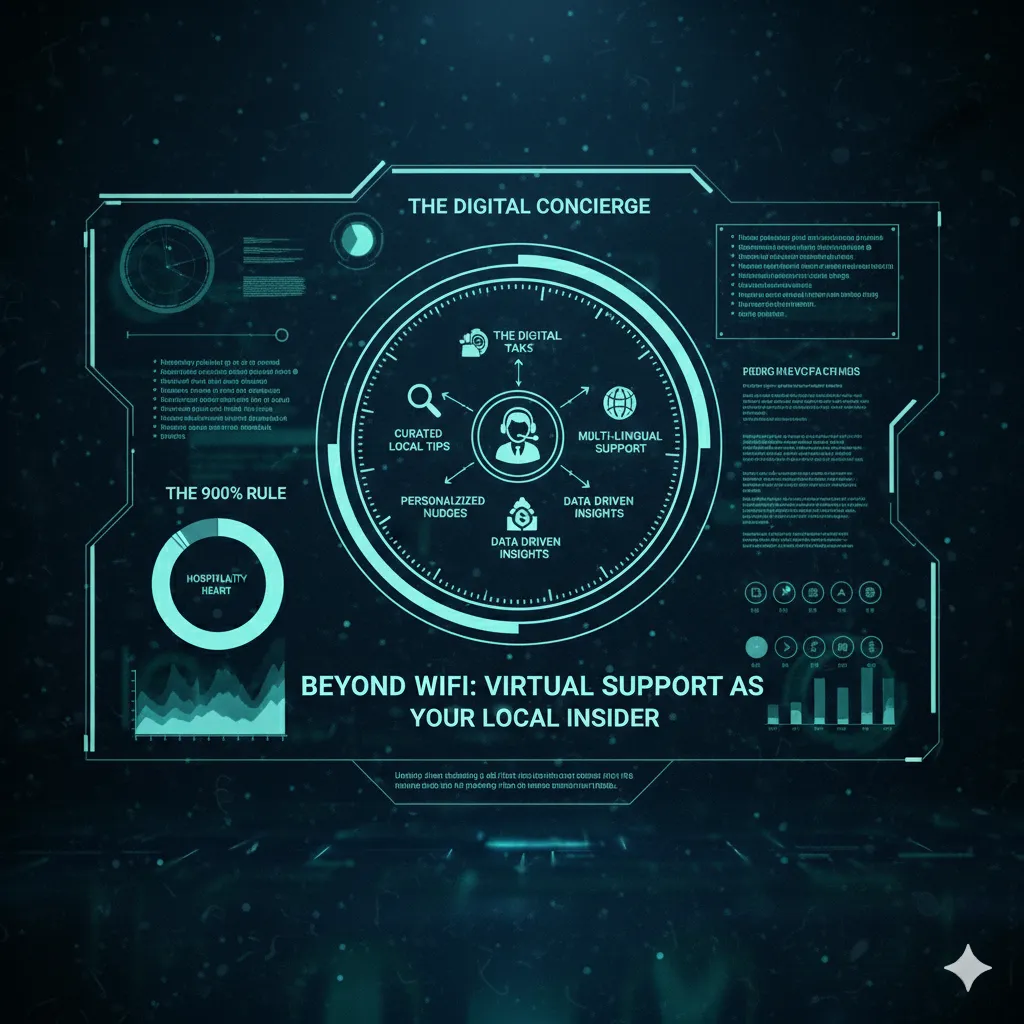
The Concierge Dilemma: Scaling 'The Local Insider' Without the Burnout
In the hospitality/property business, we often say that guests "book the room but stay for the neighborhood." Whether you manage a hotel or an STR, your role inevitably shifts from 'Property Manager' to 'Local Tour Guide' the moment a guest drops their bags.
The questions are relentless: "Where is the best espresso within walking distance?" "Is there a quiet workspace with fast WiFi?" "Which grocery store stays open past 10 PM?"
Providing these answers is the "soul" of hospitality, but in 2026, manually answering these ten times a day is a recipe for operational gridlock. This is where Virtual Front Desk Support moves from being a "luxury" to a strategic necessity.
1. The 24/7 Knowledge Base: Hospitality That Never Sleeps
The most frustrating part of guest communication isn't the difficulty of the questions, it’s the timing. A guest arriving on a delayed flight at 11:30 PM needs a dinner recommendation now, not when you wake up at 7:00 AM.
Virtual Front Desk Support acts as a "Digital Librarian" for your property’s unique local knowledge.
Instant Fulfillment: Unlike a human concierge who might be busy with a check-in, the virtual desk responds in seconds. This "Zero-Wait" service is a primary driver of 5-star reviews in the 2026 market.
Multimedia Integration: Your virtual support doesn't just name a restaurant; it can provide a direct Google Maps pin, a link to the digital menu, and even photos of the atmosphere.
Multi-Lingual Fluency: In an increasingly global market, your virtual concierge can provide these local gems in the guest’s native language—instantly breaking down barriers and making international travelers feel at home.
2. Personalized Nudges: The End of the Generic PDF
We’ve all seen the "Welcome Binder" gathering dust on a coffee table. Guests don't want a 20-page manual; they want relevant information delivered at the "Moment of Intent."
With Virtual Front Desk Support, you can move toward "Predictive Hospitality":
Segmented Suggestions: If the system recognizes a "Digital Nomad" profile, it can proactively suggest the best local co-working spots or cafes with reliable fiber-optic internet.
Group-Specific Logic: For a family checking in, the support can highlight the nearest park with a playground or a kid-friendly diner. For a college student prospect, it points out the safest walking paths to campus landmarks.
Weather-Adjusted Tips: If the local forecast calls for rain, the virtual support can pivot from "best hiking trails" to "top local museums and indoor markets" without you lifting a finger.
3. Bridging the 'Human Touch' Gap
A common fear is that automation feels cold. However, the Deloitte 2026 Future of Hospitality Report highlights a concept called "Breakthrough Efficiency." The data shows that when you automate the routine, you actually save your human energy for the "High-Value Interactions."
By delegating the 15th "where is the best coffee?" question of the day to your Virtual Front Desk, you reclaim the mental bandwidth to handle the truly complex situations, like a personalized welcome for a honeymooning couple or resolving a real-time maintenance issue.
You aren't removing the "heart" of your property; you are protecting it.
4. The Data Dividend: Learning What Your Guests Love
Every question asked of your Virtual Front Desk is a data point. Over time, you gain a "Heat Map" of guest interests:
Are 80% of your guests asking about bike rentals? Maybe it's time to partner with a local shop for a referral fee.
Are guests constantly confused about the nearest pharmacy? You can update your automated "Arrival Guide" to include it proactively.
This feedback loop allows you to evolve your property from a "static stay" into a "dynamic experience" that feels like it was designed specifically for each guest.
The Bottom Line:
Your "Local Insider" status is your competitive edge. Virtual Front Desk Support ensures that every guest, regardless of when they arrive, gets the absolute best of your expertise. You get to be the hero of the neighborhood, and the "Conversational AI Support" does all the research.